
7 Powerful Ways AI Agents Transform Modern Automation
Integrating Agentic AI Systems: 7 Powerful Ways AI Agents Transform Modern Automation

Introduction to Agentic AI Systems
Agentic AI systems are quickly becoming a cornerstone of modern digital transformation. Instead of relying on static rules or narrowly defined models, these systems use AI agents that can plan, decide, and act with a degree of autonomy. As organisations face growing complexity, integrating agentic AI is no longer a futuristic idea. It is happening right now, and it is changing how automation works at scale.
Traditionally, automation focused on efficiency. Tasks were predefined, and outcomes were predictable. However, businesses today deal with dynamic environments where conditions change fast. This is where agentic AI systems stand out. They combine reasoning, learning, and execution in a continuous loop, enabling systems to adapt rather than simply follow instructions.
In the first 10 percent of this article, it is important to highlight that agentic AI systems are not a replacement for humans. Instead, they act as collaborative partners. They support decision-making, reduce cognitive load, and handle repetitive or complex workflows with greater consistency.
According to research published by IBM on intelligent automation, organisations that blend AI with automation frameworks see improved resilience and faster innovation cycles. This insight underlines why agentic AI is gaining attention across industries.
Understanding AI Agents and Autonomous Decision-Making
AI agents are the building blocks of agentic AI systems. An AI agent is a software entity capable of perceiving its environment, making decisions, and taking actions to achieve specific goals. Unlike traditional scripts, AI agents evaluate context and adjust behaviour accordingly.
What makes AI agents particularly powerful is their ability to operate semi-independently. They do not wait for constant human input. Instead, they rely on defined objectives, constraints, and feedback mechanisms. Over time, they learn what works and what does not.
In practical terms, AI agents can:
Monitor systems in real time
Identify patterns or anomalies
Choose the best course of action
Learn from outcomes and refine future decisions
This capability is central to agentic AI systems. When multiple agents collaborate, the system becomes more resilient and flexible. Each agent focuses on a specific task, yet contributes to a broader organisational goal.
What Makes Agentic AI Different from Traditional AI
Traditional AI models are often task-specific. They excel at narrow problems such as image recognition or text classification. However, they struggle when the environment changes or when multiple objectives conflict.
Agentic AI systems, on the other hand, are goal-driven. They are designed to reason across tasks, prioritise actions, and coordinate with other agents. This difference is subtle but important.
Core Components of Agentic AI Systems
At a high level, agentic AI systems include:
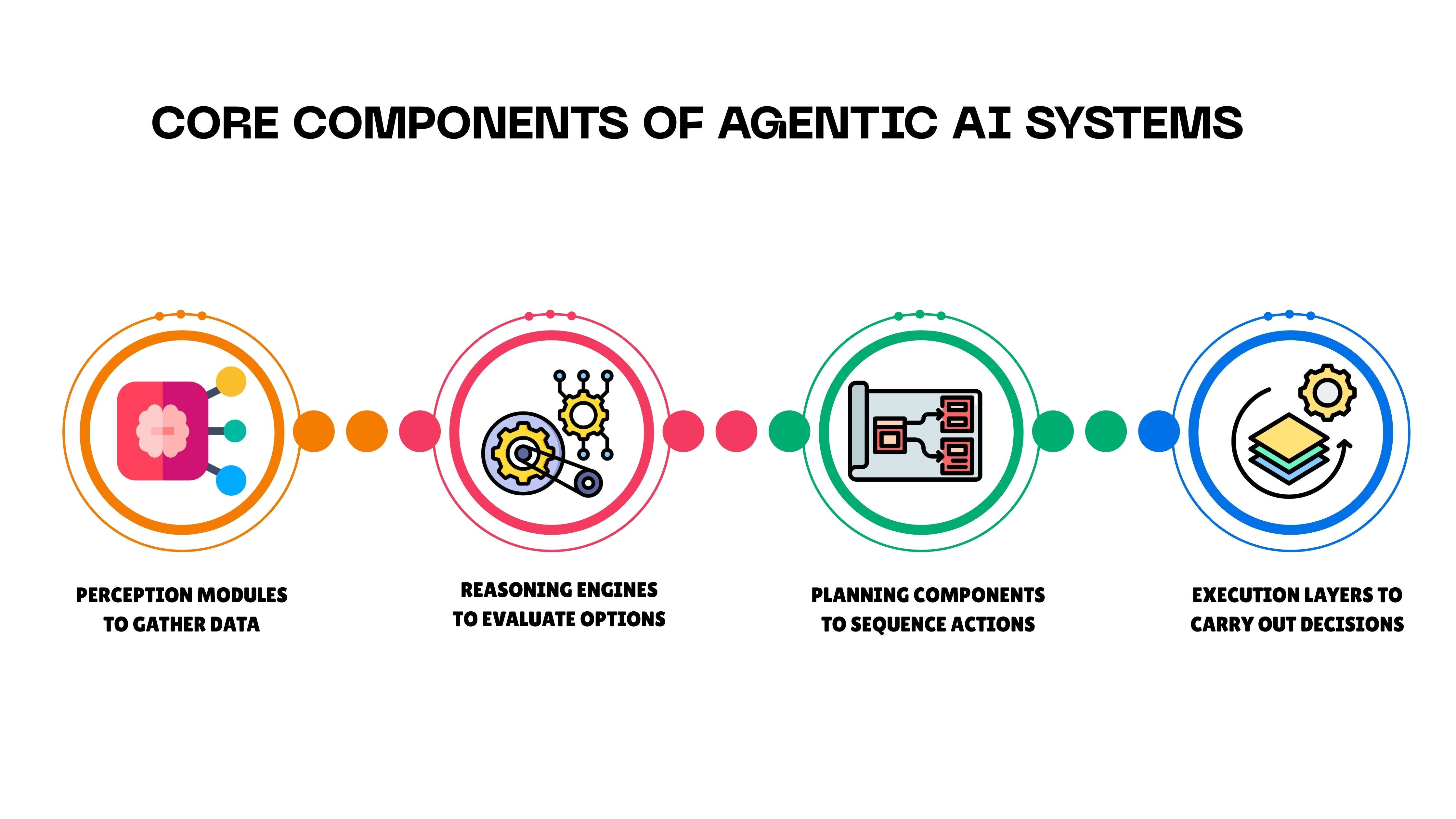
Perception modules to gather data
Reasoning engines to evaluate options
Planning components to sequence actions
Execution layers to carry out decisions
Each component works together in a continuous cycle. This structure allows AI agents to respond intelligently rather than mechanically.
Role of Data, Models, and Feedback Loops
Data fuels every agentic AI system. However, raw data alone is not enough. Models interpret data, while feedback loops ensure continuous improvement. When an action leads to a positive outcome, the system reinforces that behaviour. When it fails, the agent adjusts its strategy.
This learning loop is what enables agentic AI systems to operate effectively in uncertain environments.
Agentic AI Orchestration Explained
Agentic AI orchestration refers to the coordination of multiple AI agents working towards shared objectives. Without orchestration, agents may act in isolation, leading to inefficiencies or conflicts.
Coordination Between Multiple AI Agents
Orchestration layers manage how agents communicate and collaborate. They define roles, priorities, and escalation paths. For example, one agent may detect an issue, another may analyse it, and a third may resolve it.
This structured collaboration mirrors how human teams operate. It also ensures that agentic AI systems remain aligned with organisational goals.
Governance, Ethics, and Control Layers
Governance is critical. Orchestration frameworks include ethical guidelines, compliance checks, and human-in-the-loop mechanisms. These controls build trust and reduce risk, especially in regulated industries.
Agentic AI and Robotic Process Automation (RPA)
Robotic process automation (RPA) has long been used to automate repetitive tasks. However, traditional RPA is rule-based and brittle. When conditions change, scripts break.
By integrating agentic AI systems with robotic process automation (RPA), organisations move from rigid automation to intelligent automation.
From Rule-Based Automation to Intelligent Automation
Agentic AI enables RPA bots to make decisions rather than follow static rules. For example, instead of failing when data is incomplete, an AI-powered bot can infer missing information or escalate intelligently.
This combination improves scalability, reduces errors, and enhances overall process resilience.
Key Benefits of Integrating Agentic AI Systems
Integrating agentic AI delivers several advantages:
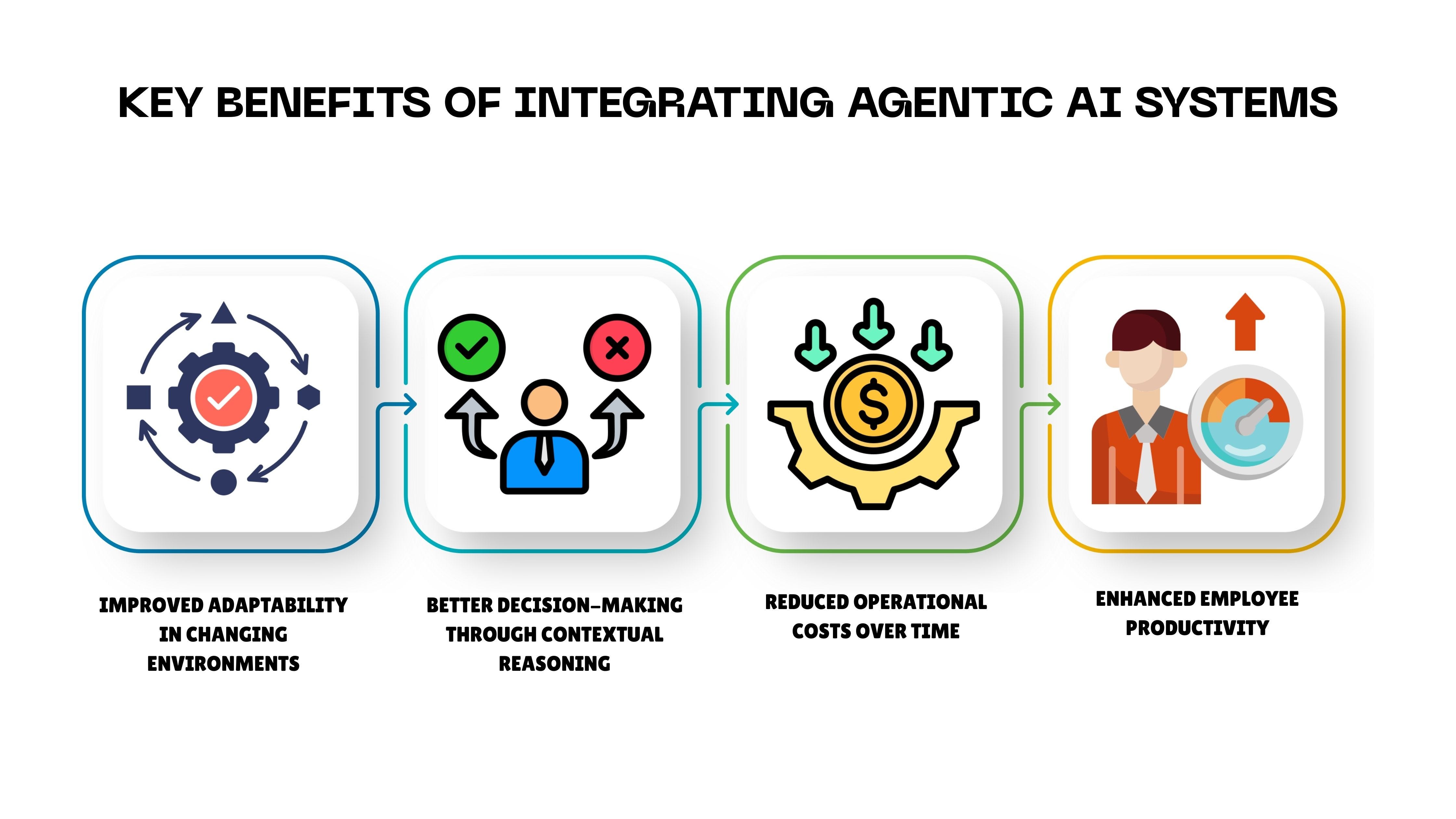
Improved adaptability in changing environments
Better decision-making through contextual reasoning
Reduced operational costs over time
Enhanced employee productivity
These benefits explain why agentic AI systems are becoming a strategic priority for forward-thinking organisations.
Real-World Use Cases Across Industries
Healthcare
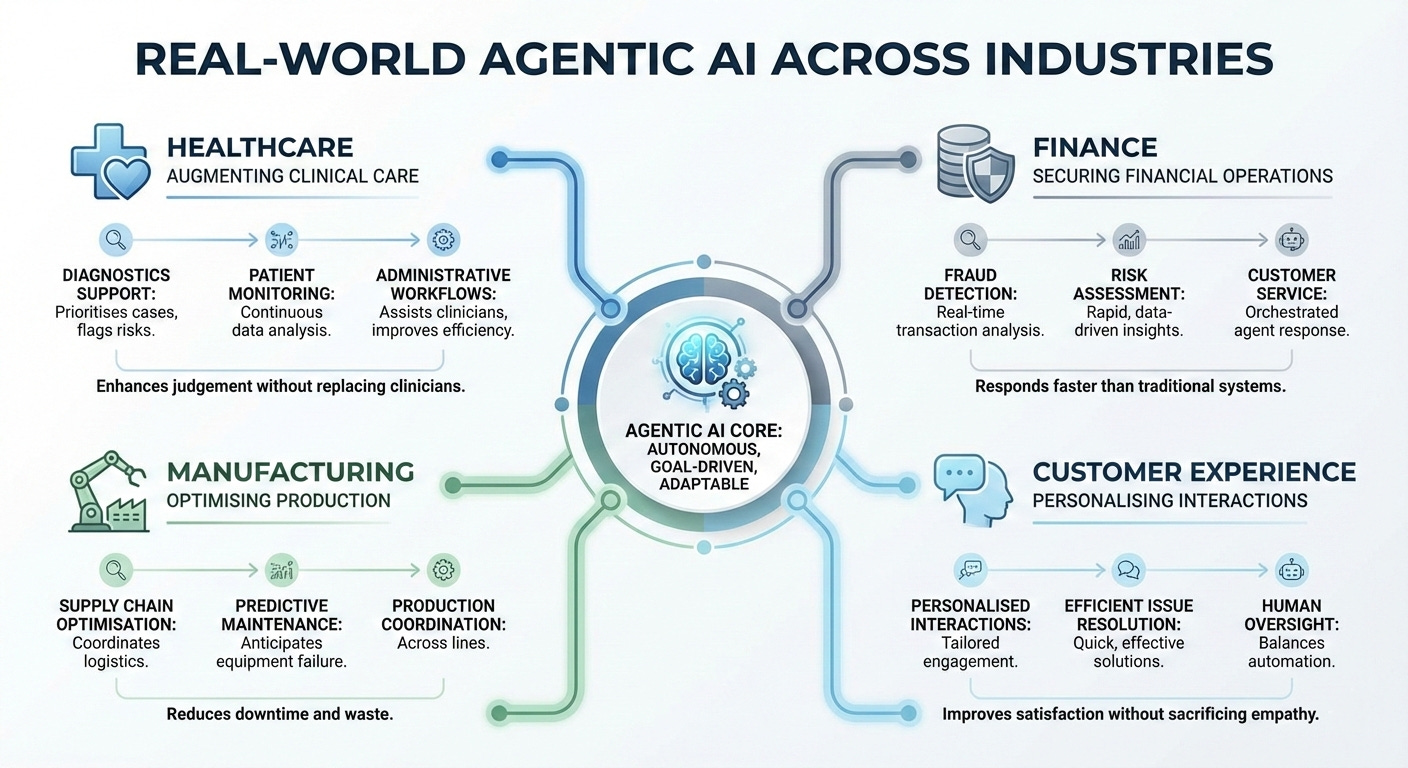
In healthcare, agentic AI systems support diagnostics, patient monitoring, and administrative workflows. AI agents can prioritise cases, flag risks, and assist clinicians without replacing human judgement.
Finance
Financial institutions use AI agents for fraud detection, risk assessment, and customer service. Orchestrated agents analyse transactions in real time and respond faster than traditional systems.
Manufacturing
Manufacturers rely on agentic AI to optimise supply chains and predictive maintenance. AI agents coordinate across production lines, reducing downtime and waste.
Customer Experience
In customer support, AI agents personalise interactions and resolve issues efficiently. When combined with human oversight, they improve satisfaction without sacrificing empathy.
Implementation Challenges and How to Overcome Them
Despite the promise, implementing agentic AI systems is not without challenges. Common issues include data quality, integration complexity, and skills gaps.
To overcome these barriers:
Start with clear use cases
Invest in data governance
Build cross-functional teams
Pilot before scaling
Experience shows that gradual adoption reduces risk and builds confidence.
Security, Compliance, and Trust in Agentic AI
Security is a top concern. Agentic AI systems must protect sensitive data and comply with regulations. Encryption, access controls, and audit trails are essential.
Trust also depends on transparency. Explainable AI techniques help stakeholders understand how decisions are made, reinforcing confidence in AI agents.
Measuring ROI and Business Impact
Measuring return on investment involves more than cost savings. Organisations should track:
Process efficiency
Decision accuracy
Employee satisfaction
Customer outcomes
These metrics provide a holistic view of value delivered by agentic AI systems.
Future Trends in Agentic AI Systems
Looking ahead, agentic AI will become more collaborative and context-aware. Advances in multimodal models and real-time reasoning will expand use cases further.

As standards mature, agentic AI orchestration will become easier to implement, accelerating adoption across sectors.
Frequently Asked Questions (FAQs)
What are agentic AI systems in simple terms?
Agentic AI systems are AI-driven frameworks where autonomous AI agents can plan, decide, and act to achieve goals with minimal human intervention.
How do AI agents differ from traditional bots?
AI agents reason and adapt, while traditional bots follow fixed rules. This makes agents more flexible and resilient.
Can agentic AI work with robotic process automation (RPA)?
Yes, combining agentic AI with robotic process automation (RPA) creates intelligent automation that adapts to change.
Is agentic AI suitable for small businesses?
With the right tools and clear use cases, small businesses can benefit from agentic AI systems on a smaller scale.
How is agentic AI orchestration managed?
Through orchestration layers that coordinate tasks, manage priorities, and enforce governance.
Are agentic AI systems secure and compliant?
When designed correctly, they include security, compliance, and ethical controls to ensure safe deployment.
Conclusion
Agentic AI systems represent a major shift in how automation is designed and deployed. By integrating AI agents, agentic AI orchestration, and robotic process automation (RPA), organisations gain systems that think, adapt, and collaborate.
The journey requires careful planning and expertise, but the rewards are significant. As technology matures, agentic AI will play a central role in building resilient, intelligent, and human-centred digital ecosystems.